
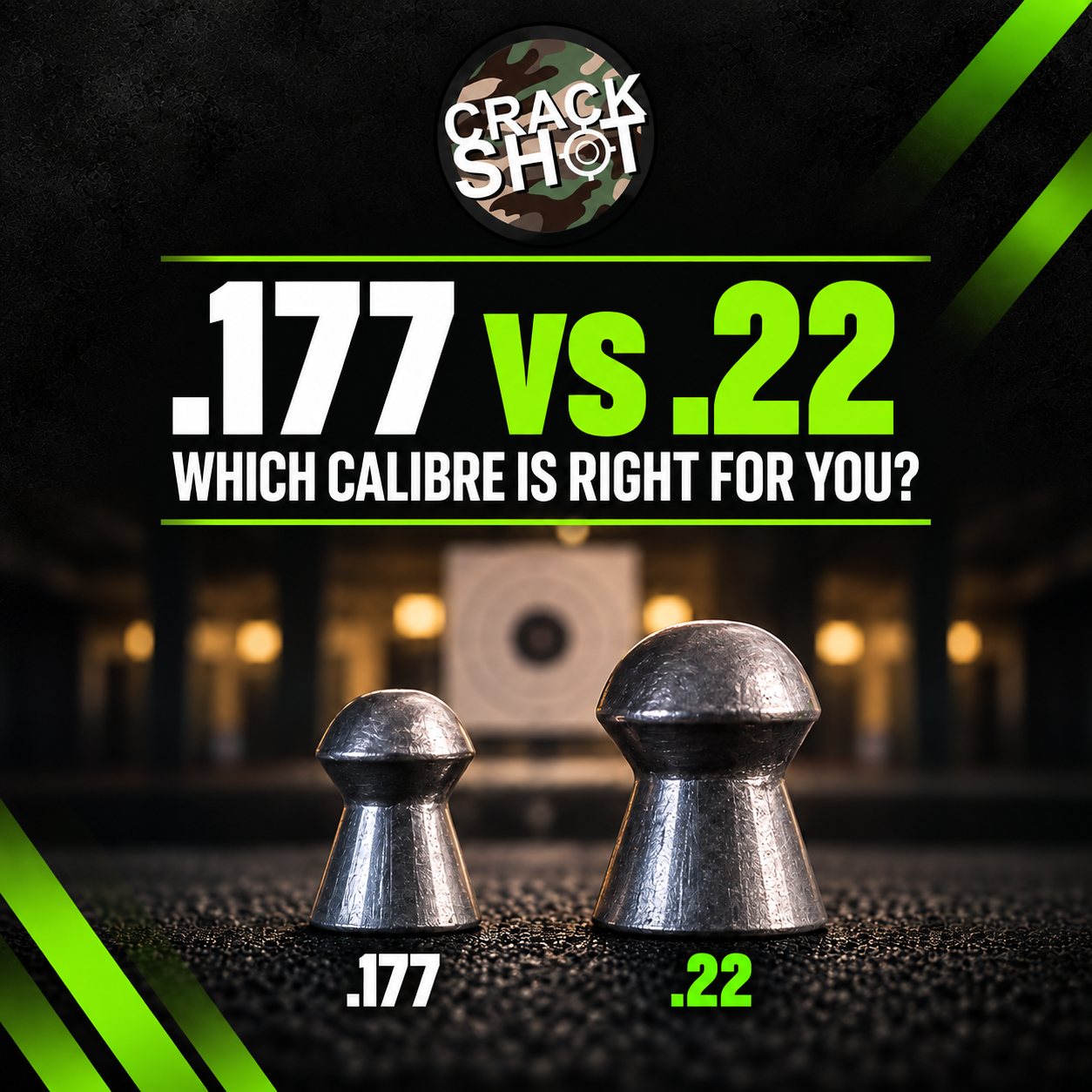
“Should I choose a .177 or .22 air rifle?”
It is one of the most common questions asked by people buying an airgun. With different shooters recommending different calibres, it can quickly become more confusing than it needs to be.
The simple answer is that neither calibre is automatically better.
A .177 air rifle is widely used for target shooting because its lighter pellet usually travels faster and follows a flatter path. A .22 air rifle fires a larger, heavier pellet and is often preferred for suitable pest-control work and general plinking.
The right choice depends on what you actually want to do with the airgun.
Is .177 or .22 better?
Choosing between .177 and .22 should begin with four things:
- What you will mainly be shooting
- The distances at which you expect to shoot
- The availability of suitable pellets
- Which calibre gives you the most confidence
Advice from other shooters can be useful, but their priorities may be different from yours. A calibre that is right for one person may not be the most suitable choice for somebody else.
Is .177 a good calibre for target shooting?
A .177 pellet is smaller and lighter than a .22 pellet. When fired from air rifles producing similar power, it will usually travel faster and follow a flatter path.
A flatter pellet trajectory can make it easier to judge where to aim when shooting at different distances. This is one reason why .177 is commonly used for:
- Paper target shooting
- Plinking
- Field Target
- Hunter Field Target
If you mainly want an air rifle for target shooting, a .177 will often be a suitable place to start.
That does not mean every .177 rifle will perform in exactly the same way. The rifle, pellet, scope, shooting distance and the person behind the trigger all affect the results.
When might a .22 air rifle be more suitable?
A .22 pellet is larger and heavier. When compared with a .177 air rifle producing similar power, it will usually travel more slowly and follow a more curved path.
This makes judging the distance and understanding where to aim particularly important.
Many shooters prefer .22 air rifles for suitable pest-control work where it is lawful, appropriate and humane. Other shooters simply enjoy using a heavier pellet for targets or general plinking.
It is important not to think of .177 as being suitable only for targets or .22 as being suitable only for pest control. Both calibres can be used for different types of shooting.
Your intended use and ability to place the pellet accurately matter more than simply choosing the larger calibre.
What about .20 and .25 airgun calibres?
You may also come across less-common airgun calibres such as .20 and .25.
A .20 calibre is sometimes described as offering characteristics of both .177 and .22, while .25 fires a larger and heavier pellet. These calibres can suit particular rifles and types of shooting, but the choice of rifles and pellets may be more limited.
For most people choosing their first airgun, the decision will begin with a comparison between .177 and .22.
Why does airgun pellet choice matter?
Choosing the right calibre is only one part of finding the right airgun and pellet combination.
Individual air rifles can perform better with particular pellet brands, shapes and weights. Two rifles of the same model may not necessarily produce their best results with exactly the same pellet.
A suitable pellet should produce reliable and consistent groups through your own rifle. That is more useful than choosing one because of a claim on the tin or because another shooter recommends it.
Where possible, test a selection of suitable pellets and compare how consistently they perform. Once you find a pellet your rifle prefers, check the zero again before relying on that combination.
Questions to ask before choosing your calibre
Before deciding between a .177 and .22 air rifle, consider the following:
- What will you spend most of your time shooting?
- At what distances will you normally shoot?
- Will the rifle mainly be used for target shooting, plinking or suitable pest control?
- Are good-quality pellets in that calibre readily available?
- Have you had the opportunity to try both calibres?
- Which option feels comfortable and gives you confidence?
These questions are more helpful than choosing a calibre simply because another shooter says it is the one you should have.
Should you try .177 and .22 before choosing?
If you have the opportunity, try both calibres before making your decision.
Reading about pellet weights and trajectories is helpful, but actually shooting both options can make the differences easier to understand. You may find that one calibre feels better suited to you and the type of shooting you enjoy.
Trying before deciding also gives you an opportunity to ask questions, compare the experience and make a more confident choice without feeling pressured.
Frequently asked questions
Which air rifle calibre is best for beginners?
There is no single calibre that is best for every beginner. A .177 is often chosen for target shooting because of its flatter trajectory, while a .22 may suit someone whose intended use and preferred shooting experience are different.
Is .177 more accurate than .22?
Calibre alone does not determine accuracy. The rifle, pellet choice, shooting distance, conditions and shooter all influence how accurately an airgun performs.
Can you use a .22 air rifle for target shooting?
Yes. Although .177 is widely used for target disciplines, many people enjoy shooting targets with a .22. The more curved trajectory makes accurate distance judgement particularly important.
Does every air rifle prefer the same pellets?
No. Air rifles can perform differently with different pellet brands, shapes and weights. Testing suitable pellets is the best way to find which one groups most consistently through your rifle.
The right calibre is the one that fits your needs
There is no air rifle calibre that is automatically right for everybody.
Start with what you actually want to do. Consider your usual shooting distances, the type of targets you will be shooting, pellet availability and which option gives you confidence.
Take the time to understand the differences and, if possible, try both .177 and .22 before deciding.
The right calibre is not the one somebody else tells you to choose. It is the one that fits your needs and helps you enjoy your shooting.